 Pueblo Swamp Cooler Repair
 Swamp Cooler Repair in Pueblo
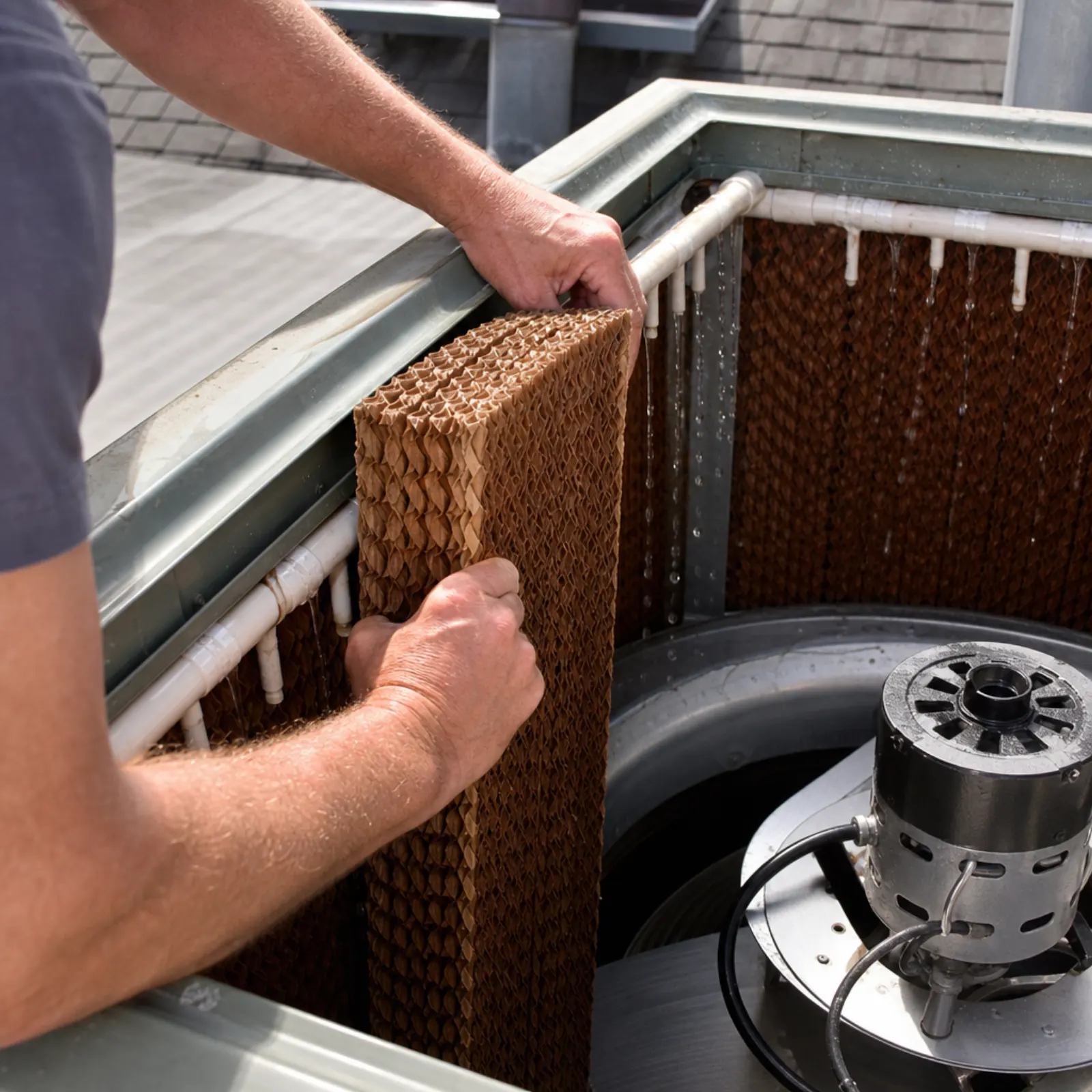
Swamp cooler repair in Pueblo starts with a $150 to $350 service call that covers the roof visit and the first hour, and most coolers are fixed inside that hour: a pump at $150 to $400, a float at $100 to $250, a belt at $40 to $100, a motor at $300 to $700. The job is naming the failed part from the symptom before anyone climbs, which is why a photo of the cooler with the panel off gets you a real number before anyone drives out. Send it, and in season ask for the visit window for a house blowing warm air; it depends on the week.
Pueblo runs on coolers because Pueblo is dry, and a cooler here has one job from the last spring freeze at the end of April to the first fall freeze in early October: turn hard river water and 93 degree air into a 70 degree living room. When it stops, it is almost always one of six parts.
Diagnose by symptom
Warm air, blower running. Water is not reaching the pads. Check in this order: the pump (dead from scale or from running dry), the float (stuck closed, pan empty), the pads (crusted with mineral so they shed water instead of soaking it), and the supply line (shut at the hose bib, kinked, or split from a winter freeze). On a July roof in Belmont this is the most common call, and the fix is usually a pump or a float on the spot.
No air, motor humming. Drive problem. A broken or thrown belt, a slipping belt that squeals, a seized blower bearing, a failed start capacitor, or a burned motor. A hum with no movement means the motor is trying against something. Belt, bearings, and capacitor should be checked before anyone says the word “motor,” because a $100 capacitor has saved plenty of motors that were about to be condemned.
Water on the roof or down the stucco. The float is set high or stuck open, the overflow standpipe is missing or clogged, or the pan has rusted through. Either of those first two runs $100 to $250 to put right. The third is the end of the cooler, and sealing a pan that will open again by August is money wasted. Overflow also rots roof decking under the curb, so a fast look is worth it.
Smell. A stagnant pan, algae on the pads, or aspen pads past their life. Pueblo’s hard water leaves a crust that traps grime, and a cooler that sat through a warm week with the pump off grows a smell fast. Pan clean, fresh pads, and a working bleed-off fix it.
Cools some rooms, not others. Airflow. The duct damper is stuck half open, the window relief is wrong, or a two-speed switch only runs low. A cooler needs a path out of the house equal to the air coming in; closed windows are the most common “repair” that costs nothing.
Trips a breaker or the switch does nothing. The cooler control, thermostat, two-speed switch, or a chafed lead in the cooler’s own circuit. That stays within the cooler’s control and we handle it. Anything upstream at the panel is licensed electrician work.
Why Pueblo coolers fail the way they do
Scale. Pueblo Water diverts the Arkansas River at Pueblo Reservoir and treats it at the Whitlock plant, and its published total hardness averages 180 mg/L, 10.5 grains per gallon, with a reading of 240 mg/L, 14.0 grains, on September 4, 2026. Hardness drops during summer runoff and rises in winter, but a cooler evaporates hundreds of gallons across a season and leaves every grain of mineral in the pan. That crust seizes pump impellers, sticks floats, and turns aspen pads into cardboard by August. Homes on private wells around Penrose and the county edges see it faster. The pads, pumps, floats, and motors page covers the parts and the bleed-off fix.
Heat. With 71.6 days a year at or above 90 degrees and 3,461.8 hours of sunshine, a black roof in Sunset Park bakes the belt and dries out blower bearings that nobody oiled since the cooler was installed.
Freeze. NWS Pueblo puts the mean first fall freeze at October 8, with a 90 percent chance by October 20 and a record early date of September 9. A cooler left full into that night splits its quarter-inch supply line and often cracks the float and pump housing. The most common April repair in this city is a cooler that was never drained; the shutdown page exists to prevent it.
Humidity, briefly. The National Weather Service describes the monsoon reaching Colorado around the second week of July and usually finishing by the end of August in bursts and breaks. Pueblo’s mean dew point is 51.1 degrees in July and 51.6 in August, and a surge pushes it higher. Above about 60 the pads cannot pull much out of the air. In late July 2026, monsoon moisture sat over the region from the 22nd through the 25th with flash flood watches, and every cooler in Pueblo felt sticky. That is not a repair. It is weather, and the conversion page covers the alternative honestly.
How a repair visit goes
- Roof access and a full look. Side panels off. Pads, pan, pump, float, belt, motor, water line, and the down-duct damper all get inspected before anyone quotes a part. A dead pump with a crusted pad set behind it gets both mentioned and priced separately.
- Test, do not guess. Pump-only mode to check water delivery; low and high to check the drive; a look at the overflow with the float lifted.
- Repair with matched parts. A bigger cooler needs a higher-GPH pump and larger pads, so we size both to the CFM. A two-speed motor is not a single-speed motor with an extra wire. Our techs usually carry the common Pueblo sizes.
- Balance. Pad saturation checked on every side, the bleed-off or purge pump set to fight scale, the damper and window relief adjusted so air actually leaves the house.
- Every speed tested and the ladder comes down with you knowing what to watch for.
Repair or replace
The pan and frame decide it. A cooler with a sound galvanized or polymer pan is worth every repair on the pricing page, because even a $700 two-speed motor is a fraction of a new unit. A pan that has rusted through, a frame that flakes when you touch it, or a cooler on its third patch is done, and putting a new pump in it is throwing money after a box that will leak again. On the mid-century ranches of Belmont and Eastwood Heights, where the original coolers can be decades old, this call comes up often, and the installation page explains what a replacement costs and what the county requires.
What it costs
| Repair | Range |
|---|---|
| Service or diagnostic call (roof visit + first hour) | $150 to $350 |
| Pump, installed | $150 to $400 |
| Float valve | $100 to $250 |
| Belt | $40 to $100 |
| Capacitor, switch, thermostat | $100 to $300 |
| Motor | $300 to $700 |
| Water line repair | $100 to $400 |
Drivers are the part, the cooler size, and roof access. A low-slope ranch roof with a down-draft cooler on a curb over the hall is the bottom of the range. A steep Mesa Junction roof with a two-speed motor and a rusted belt guard is the top. If you want the range before you call, the free calculators build it from this same table, and the problem pages work through each symptom in turn.
Cooler repair is covered across Pueblo and out to Pueblo West, Colorado City, Penrose, Florence, and Cañon City. Send a photo of the inside of the cooler, one of the belt and motor, and one of the switch in the house, so we can give a straight answer on what failed and what it costs.
Frequently Asked Questions
How much is a swamp cooler service call in Pueblo?
$150 to $350, and that covers the roof visit and the first hour. Most jobs wrap up inside that hour, which makes the bill the call plus whatever part failed: $150 to $400 for a pump, $100 to $250 for a float, $40 to $100 for a belt, $300 to $700 for a motor. A photo of the cooler with the panel off usually gets you the likely part and a firm range before anyone drives out.
How soon can you come out?
In season it depends on the week. Warm-air and no-air calls go fastest because our techs usually carry the common Pueblo pump sizes, floats, belts, capacitors, and aspen pads. Rigid media and two-speed motors come in too many sizes to stock, so those get ordered. The busiest weeks are the first hot stretch in June and the monsoon break in August, so send the photos early in the day.
Is it worth repairing an old cooler or should I replace it?
If the pan and frame are sound, repair. Next to a $1,500 to $4,000 replacement, even a motor is cheap, and a pump, float, or belt is cheaper still. If the pan has rusted through, the frame is corroded, or you are on the third patch, the honest answer is replacement, and photos usually show it before anyone sells you another pump.
Why does my cooler work in June and quit in August?
Usually two things at once. Pads that were fresh in April are crusted with scale by August, and the monsoon pushes Pueblo's mean dew point from 43.9 degrees in June to 51.6 in August, higher during a surge. Fresh pads and a working bleed-off fix the first; nothing fixes the second except drier air or refrigerated cooling.
Do you fix window coolers and side-drafts too?
Yes. Window units and wall-mounted side-drafts are common on Mesa Junction and Bessemer houses with steep roofs or finished attics, and they fail the same way: pump, float, pads, belt, motor. The only difference is access, which is usually easier than a roof.
More swampcooler services
Areas we serve
- Pueblo, CO
- Swamp Cooler Repair in Avondale, Colorado
- Swamp Cooler Repair in Beulah, Colorado
- Swamp Cooler Repair in Boone, Colorado
- Swamp Cooler Repair in Cañon City, Colorado
- Swamp Cooler Repair in Colorado City, Colorado
- Swamp Cooler Repair in Florence, Colorado
- Swamp Cooler Repair in Penrose, Colorado
- Swamp Cooler Repair in Pueblo West, Colorado
- Swamp Cooler Repair in Rye, Colorado