 Pueblo Swamp Cooler Repair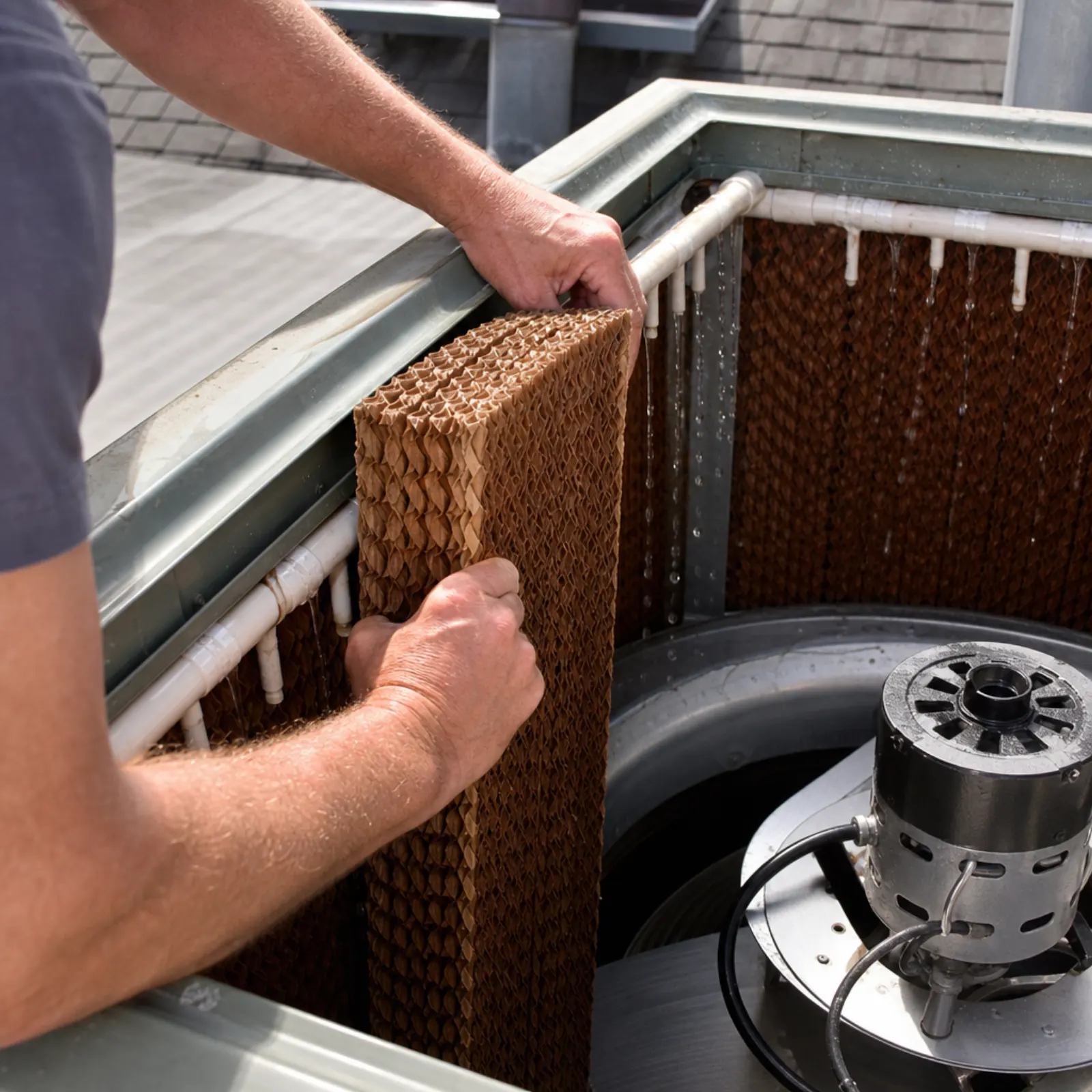
Pueblo Swamp Cooler Repair repairs, services, and replaces evaporative coolers across Pueblo, Pueblo West, and the lower Arkansas Valley. A service call runs $150 to $350 and covers the roof visit and the first hour; pumps and floats are $100 to $400, motors $300 to $700, a spring start-up $120 to $250, and a new roof-mount cooler installed $1,500 to $4,000. Send a photo of the cooler with the panel off for a straight diagnosis and a real number, and in season ask for a visit window along with the quote when a roof is blowing warm air in July.
Dry air is the whole reason a swamp cooler earns its keep in Pueblo. At 4,692 feet, with an average of only 12.02 inches of precipitation a year and 3,461.8 hours of sunshine, the air has room to take on water, and a box of wet pads on the roof turns a 93 degree afternoon into a 70 degree living room for the cost of running a blower motor. The catch is that the same climate that makes coolers work also breaks them: hard river water scales the pump and pads, the roof bakes the belt, and a hard freeze splits any water line that was not drained in October. Our job is keeping that box working, or telling you honestly when it is time to replace it.
What gets fixed
- Swamp cooler repair: no air, warm air, water on the roof, squeals, hums, smells, and electrical faults diagnosed by symptom and fixed on the first visit when the part is on our truck.
- Spring start-up service: pan cleaned, pads replaced, bearings oiled, belt tensioned, float set, water line checked, every speed tested.
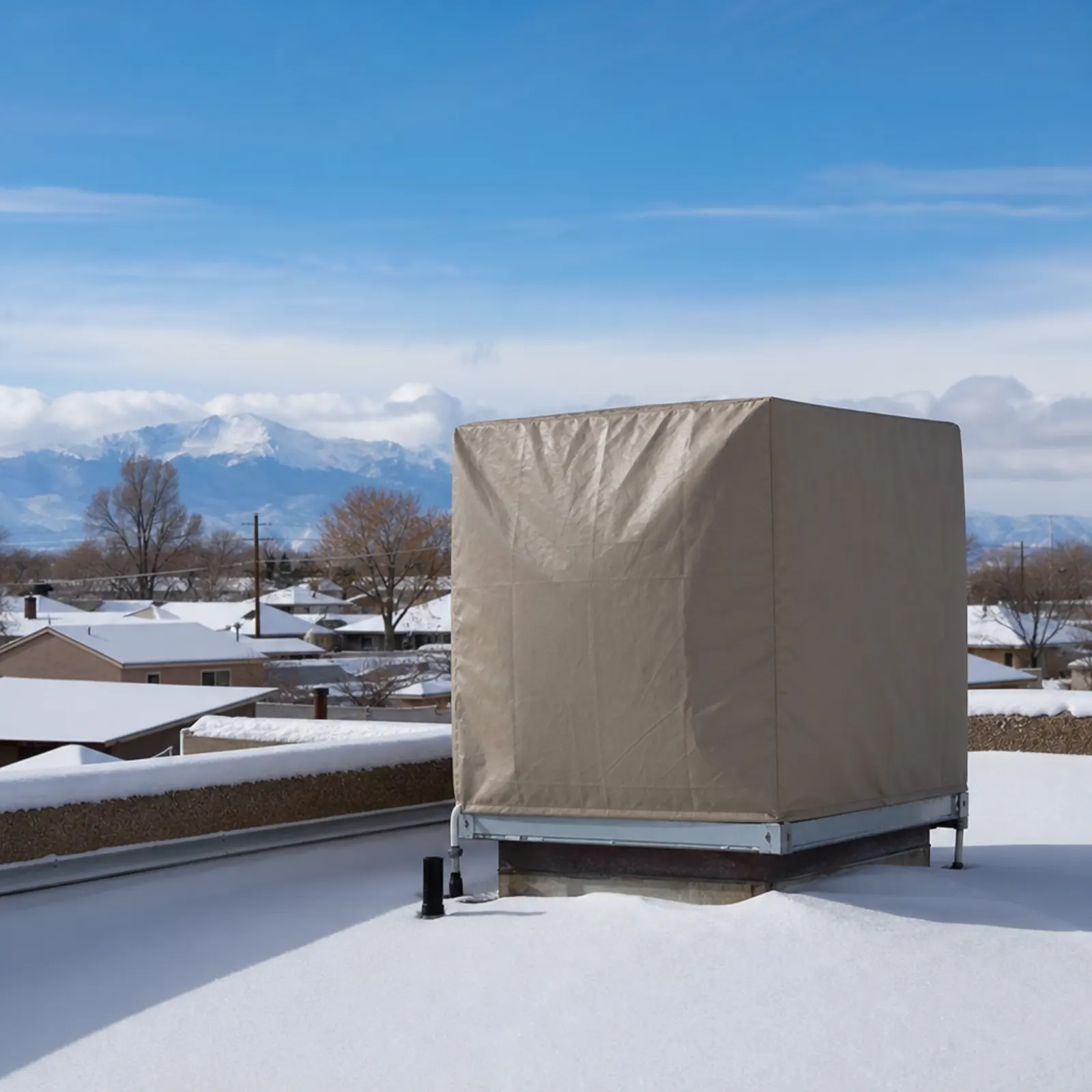
- Fall shutdown and winterization: we shut the water, drain the line and the pan, pull or dry the pads, cover the cooler, and seal the duct damper before the cold sets in.
- Pads, pumps, floats, and motors: the wear parts that fail every few seasons, replaced with the right GPH, pad size, and horsepower for your cooler’s CFM.
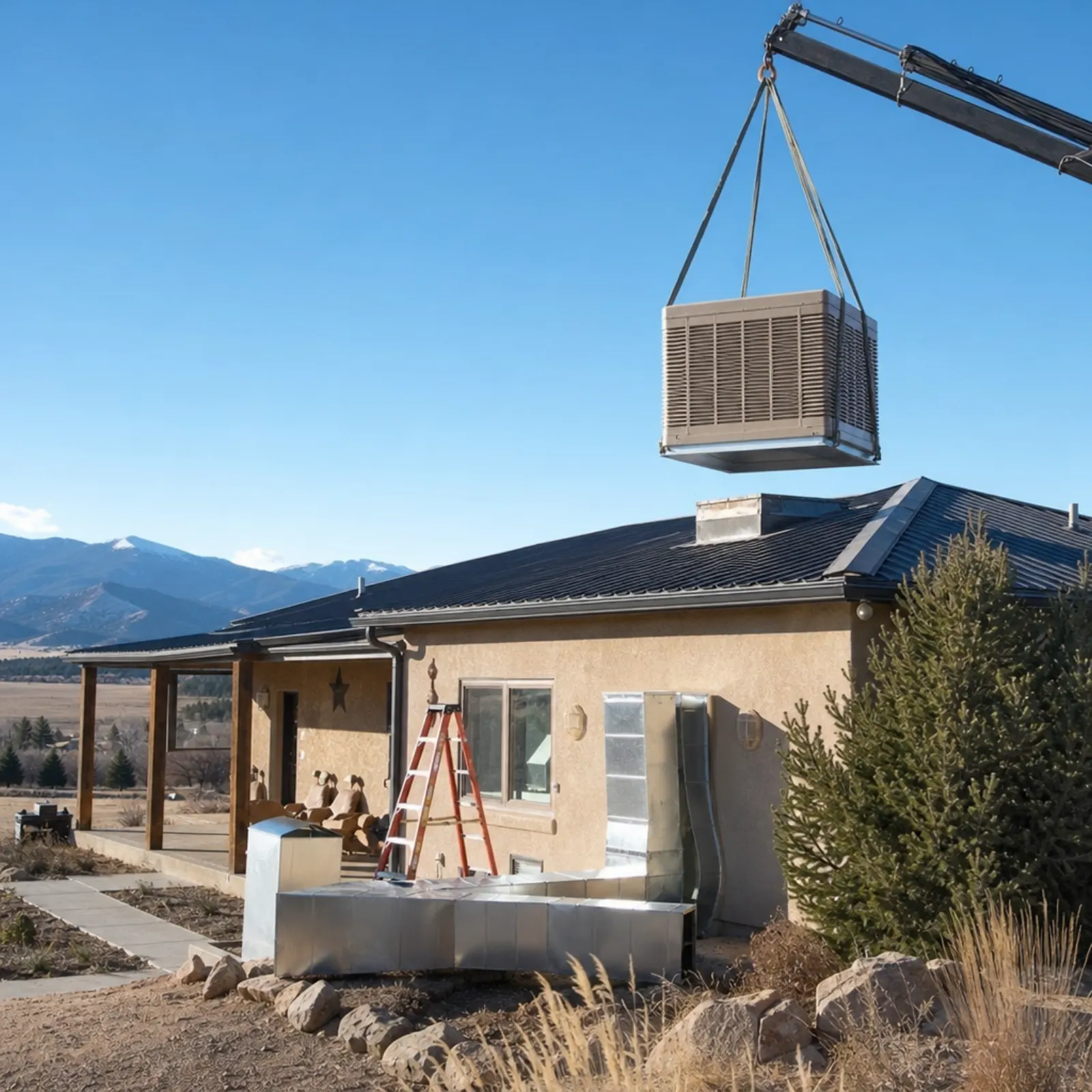
- Swamp cooler installation and replacement: new roof-mount, side-draft, or window coolers sized to the house and ducted properly.
- Cooler-to-AC conversion: honest numbers on central air and mini-splits for the homeowners who are done with pads, without pushing anyone off a system that works.
If you would rather start from the symptom than the service, the problem pages walk through what the cooler is doing and what the fix costs, and the free calculators price a repair or a month of running costs on the page with no email.
Why Pueblo is swamp cooler country
The air is dry enough, most of the summer. NOAA’s 1991-2020 normals for Pueblo Memorial Airport put the July normal high at 93.4 degrees and the August high at 90.2, with 71.6 days a year reaching 90 or hotter. What makes that heat cooler-friendly is the dew point. The Western Regional Climate Center’s monthly means for the airport show a June dew point of 43.9 degrees and a May dew point of 36.6, and at those numbers a well-padded cooler drops incoming air 20 to 25 degrees. That is why the mid-century ring of Belmont, Sunset Park, and Eastwood Heights, the steelworker blocks of Bessemer, and the older grid around Mesa Junction still have coolers on the roof: they were built before central air was standard, and in this climate a cooler was the right call.
The monsoon is the exception. The National Weather Service describes the North American monsoon reaching Colorado around the second week of July and usually finishing by the end of August, in bursts of moisture and breaks of dry air. Pueblo’s mean dew point climbs to 51.1 degrees in July and 51.6 in August, and during a surge it runs higher; the Colorado Climate Center notes that dew points above 60 are uncommon in Colorado but do happen, especially on the eastern plains, and 60 is where a cooler starts to feel like a humidifier. In July 2026, monsoon moisture sat over the region from the 22nd through the 25th with flash flood watches, and every cooler in town felt sticky for those four days. A cooler is not broken on those afternoons. It is doing what physics allows. The conversion page covers the options for households who cannot live with that.
The water is hard. Pueblo Water diverts the Arkansas River at Pueblo Reservoir and treats it at the Whitlock plant, and its published total hardness averages 180 mg/L, or 10.5 grains per gallon, with the plant reporting 240 mg/L (14.0 grains) on September 4, 2026. Hardness is lower during summer runoff and higher in winter, but every gallon that evaporates off your pads leaves all of its minerals behind. Over a season that becomes a white crust on aspen pads, a scaled impeller in the pump, and a float valve that sticks. It is the number one reason pumps die here, and the reason a bleed-off line or purge pump is worth having. Pueblo West treats its own Twin Lakes water, Colorado City runs on Lake Beckwith, and the Fremont County towns each treat Arkansas River water; scale is a fact of life across the whole service area.
The freeze is real and it comes early. NWS Pueblo’s climate records put the mean first fall freeze at October 8, with a 50 percent chance of 32 degrees by October 5 and a 90 percent chance by October 20. The earliest on record is September 9, in both 2001 and 2020, and last year’s first freeze was October 19, 2025, at 27 degrees. A cooler left full of water into that first hard night splits its quarter-inch supply line, and sometimes the float and pump housing too. A common spring repair is a cooler that was never drained. The fall shutdown page has the checklist.
Spring comes late. The mean last spring freeze is April 29, with a 90 percent chance of another 32 degree night after April 16 and a 50 percent chance by April 30; the latest on record is June 2, 1919. That is why start-ups get booked from mid-April into May. Turn the water on in early April and a late frost can undo it.
Pueblo’s housing stock, and where the coolers are
Pueblo is an older city. The City of Pueblo’s 2025-2030 Consolidated Plan counts roughly 24,000 owner-occupied single-family homes, about 55 percent of the ownership stock, built before 1980, with an average home age over 55 years. That is the cooler market:
- Bessemer and the Minnequa blocks: the steel town that incorporated in 1886 and joined Pueblo in 1894, with hundreds of four- and five-room homes built by CF&I’s Minnequa Town Company west of the mill. Small houses and low rooflines, typically a single down-draft cooler feeding a hallway grille. Easy roof access, old wiring, and pans that have been patched more than once.
- Mesa Junction: architecture from the late 1800s to the 1960s around the old streetcar junction. Side-draft coolers through a window or wall are common here because the roofs are steep or the attics are finished.
- Belmont, Sunset Park, and Eastwood Heights: the mid-century ring. Belmont built out from the 1950s in ranch style, with most homes dating between 1940 and 1969; Eastwood Heights, the neighborhood known as Dog Patch, was established in the 1950s with ranch homes usually under 1,000 square feet. Low-slope roofs, a down-draft cooler on a curb over the hall, and the classic damper-and-window setup. This is the heart of the start-up and shutdown calendar.
- Pueblo West: founded in 1970 and grown from 4,386 people in 1990 to 33,086 in 2020, so most of its 12,533 homes are 1990s and later. Many were built with coolers, many more have added refrigerated air, and a lot of them now have both, which is exactly where a leaky duct damper costs money in both seasons. More on the Pueblo West page.
How a repair visit goes
- Roof access and a full look. We pull the panels and go over the pads, pan, pump, float, belt, motor, and water line before quoting any part. A failed pump in a sound cooler and a failed pump sitting in a rusted-out pan call for two very different talks.
- Diagnose by symptom. If the air is warm, we chase the water: pump, float, pads, supply line. If nothing blows, we chase the drive: motor, belt, capacitor, switch. Water running off the roof points at the float, the overflow, or the pan, and a bad smell points at standing water, algae, or worn-out pads.
- Repair with matched parts. The right pump GPH and pad size depend on the cooler’s CFM, and you cannot swap a single-speed motor in for a two-speed one by adding a wire. Our techs usually carry the common Pueblo sizes.
- Balance the system. We make sure every pad wets through, set the bleed-off or purge against Pueblo’s scale, and adjust the damper and window relief so air has a way out of the house.
- Run it on every speed, then tell you what to keep an eye on.
Our prices, out in the open
| Service | Typical range |
|---|---|
| Service or diagnostic call (roof visit + first hour) | $150 to $350 |
| Pump replacement, installed | $150 to $400 |
| Float valve | $100 to $250 |
| Aspen pads, per set | $80 to $200 |
| Rigid media pads | $300 to $700 |
| Belt, with the visit | $40 to $100 |
| Motor replacement | $300 to $700 |
| Spring start-up (pads extra) | $120 to $250 |
| Fall shutdown and winterization | $100 to $200 |
| New cooler installed, roof-mount or side-draft | $1,500 to $4,000 |
The full table, what moves each number, and the start-up plus shutdown package are on the pricing page. In short, three things set the price (how big the cooler is, how hard the roof is to reach, and which part died), and one photo with the panel off gets you a number with nobody coming out to sell you anything.
Who does the work, and who licenses them
Colorado does not license HVAC contractors at the state level, so this is local, and Pueblo’s arrangement changed on January 1, 2026. The old Pueblo Regional Building Department became the Southern Colorado Building Department at 830 North Main Street, which serves the City of Pueblo and the Town of Boone. Unincorporated Pueblo County, including Pueblo West, Beulah, Rye, Colorado City, and Avondale, is now served by the new Pueblo County Building Division, which requires a mechanical permit for the installation, replacement, repair, or modification of HVAC equipment and issues a Mechanical Contractor A license that requires a passing ICC exam and a current EPA card. A contractor who works both sides of the city line needs a license from each department. Out west, Fremont County’s building department on Macon Avenue in Cañon City covers the unincorporated county, and Cañon City and Florence run their own.
Pueblo Swamp Cooler Repair is an independently operated local service. Our techs handle the repairs, installations, and conversions; ask any cooler tech, us included, which local license they hold. Anything electrical beyond the cooler’s own control, and any gas work in a conversion, needs a licensed electrician or plumber, and that should be clear before it shows up on a bill.
Service area
We cover Pueblo and the county, out to Pueblo West seven miles west on US 50, south to Colorado City and the Greenhorn Valley at I-25 exit 74, and west into Fremont County to Penrose, Florence, and Cañon City. Searched “swamp cooler repair near me” from somewhere inside that map? Then you are in our area.
To start, we need three photos: the cooler with its side panel removed, the pads, and the switch or thermostat in the house. With those we can give a diagnosis, a number from the published ranges, and a realistic time. Questions first? Start with the FAQ or read about us.