 Pueblo Swamp Cooler Repair
 Spring Swamp Cooler Start-Up in Pueblo
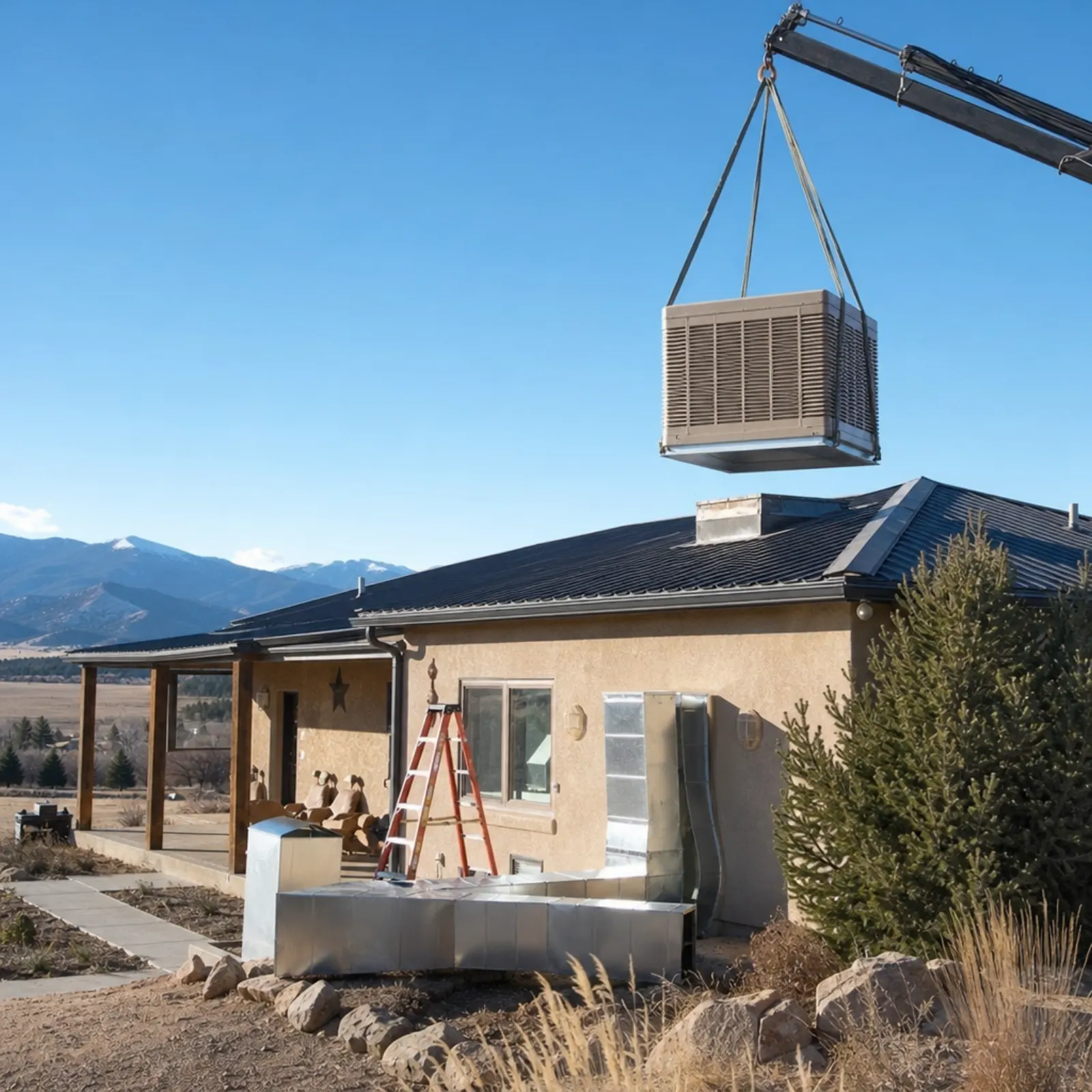
A spring swamp cooler start-up in Pueblo runs $120 to $250 in labor plus pads (aspen $80 to $200 a set, rigid media $300 to $700), and in our experience it decides whether you spend July comfortable or on the phone about warm air. We clean the pan, hang new pads, oil the blower bearings, tension the belt, set the float, look over the water line for a freeze split, and run every speed. Book it after NWS Pueblo’s mean last spring freeze of April 29, and pair it with a fall shutdown for $200 to $400 as a package.
Why the date matters in Pueblo
Spring on the Arkansas Valley floor arrives late and does not always stay. NWS Pueblo’s climate records give a mean last spring freeze of April 29 at the airport, a 90 percent chance of another 32 degree night after April 16, and a 50 percent chance by April 30. The latest freeze on record is June 2, 1919. The 28 degree hard-freeze dates run a bit earlier, April 8 at 90 percent and April 20 at 50 percent, and it is a hard freeze that splits a full water line.
So the start-up window is mid-April into May. Earlier than that and you are betting a quarter-inch copper or poly line on the roof against a Colorado cold front. Later than that and you are sweating through the first 88 degree June afternoons: NOAA’s 1991-2020 normals put Pueblo’s June normal high at 88.6 degrees, July at 93.4, with 71.6 days a year reaching 90 or hotter. May’s normal high is 77.2, which is why the smart booking is the last two weeks of April for a house that wants cooling on the first hot day rather than the first hot week.
What a start-up includes
- Cover off, panels off, full inspection. We go through the pads, pan, pump, float, belt, motor, blower bearings, roof water line, and the damper in the down-duct. Anything that failed over the winter gets found here, not in June.
- Pan cleaned. Last year’s scale, a winter of dust, and whatever the wind put in there come out. Skip it and by July the house smells like a stock pond; do it and it does not.
- New pads. Aspen pads are replaced every spring as a rule; Pueblo Water’s 10.5 grain average hardness crusts them by August, and reused aspen cools badly and smells worse. Rigid media gets a look and a rinse and goes back in, since it lasts 3 to 5 years. The pads page covers the choice.
- Pump checked and primed. We look for an impeller furred with scale, a housing cracked by ice, or an inlet screen packed shut. If it was laboring last September, it will not make it through this July, and we tell you so.
- Float set. The pan should fill to its line and shut off, and the overflow standpipe should be open. Set too high or stuck, the float puts water on the roof; set too low, it starves the pads and you get warm air.
- Bearings oiled and belt tensioned. A few drops of oil on the blower shaft bearings each spring keeps them from shrieking by August. We set the belt to the right deflection, since an over-tight belt wears out motor bearings and a slack one slips and squeals.
- Water line checked under pressure. If nobody drained it last fall, this is where you find out. Replacing a split line from the hose bib up to the cooler runs $100 to $400, depending on length.
- Damper and relief. We open and check the down-duct damper and show you which windows to crack so the air can get out.
- Every speed tested. We run pump-only, then low, then high, and do not come down until every pad face is wetting evenly.
The undrained cooler: what turns up in April
The most common start-up surprise in Pueblo is a cooler that was left full into last October’s first freeze. NWS Pueblo’s records put that first freeze at October 8 on average, and last year’s arrived October 19, 2025, at 27 degrees. Ice grew inside the supply line, the float, and the pump housing and cracked each one. By April that shows up as a line spraying the moment the valve opens, a float that never closes, or a pump that hums without moving water.
That is exactly why the start-up is worth booking, not a reason to skip it. Better that we spot the damage on the roof than you spot it as a stain on the ceiling, and every part is priced from our published ranges before it goes in. A shutdown at $100 to $200 in October would have avoided it, which is why the package exists.
Neighborhood notes
- Belmont, Sunset Park, and Eastwood Heights. The mid-century ring, built out from the 1950s in ranch style, is where most of Pueblo’s down-draft coolers sit on a curb over the hallway. Low-slope roofs, easy access, and coolers that are often original to the house. Start-ups here are quick unless the pan is rusting, and you should hear it if it is.
- Bessemer and the Minnequa blocks. Small CF&I-era homes, often a single cooler feeding a hallway grille, and wiring that has been extended more than once. The start-up includes a look at the cooler’s own control and leads.
- Mesa Junction. Steeper roofs and finished attics mean side-draft and window coolers. Same checklist, easier access, and a closer look at the wall or window seal.
- Pueblo West. Newer stock, often with both a cooler and refrigerated air. On these houses we also check that the AC return is not working against the cooler and that the damper closes fully when the AC is on. See the Pueblo West page.
The scale question, every spring
Every gallon a cooler evaporates leaves its minerals in the pan, and Pueblo Water’s published hardness averages 180 mg/L, 10.5 grains per gallon, with 240 mg/L on September 4, 2026, since hardness rises when runoff ends. If we could add one thing at start-up, it would be a bleed-off line or purge pump: it sends a trickle of mineral-loaded pan water down the drain so the minerals cannot build up. Pads last about twice as long, and the pump stops doing most of the hard work. Coolers without one get a price for it alongside the start-up.
What it costs
| Item | Range |
|---|---|
| Start-up labor | $120 to $250 |
| Aspen pads, per set | $80 to $200 |
| Rigid media pads | $300 to $700 |
| Start-up + fall shutdown package | $200 to $400 |
| Water line replacement, if split | $100 to $400 |
| Pump, if failed | $150 to $400 |
| Float, if failed | $100 to $250 |
Roof access and cooler size move the labor number. Everything else is on the pricing page.
Start-ups are covered across Pueblo and out to Pueblo West, Colorado City, Penrose, Florence, and Cañon City. For Fremont County and the Greenhorn Valley, book early in April and say which week you want it running. Not sure the cooler made it through the winter? A photo of the inside lets us tell you what we expect to find before we come out.
Frequently Asked Questions
What does a swamp cooler start-up cost in Pueblo?
$120 to $250 for the labor, with pads extra: aspen $80 to $200 a set, rigid media $300 to $700. Booked with a fall shutdown the package runs $200 to $400. Should we find a winter-split line or a pump that froze, you get the published-range price for it first, and nothing gets done until you say so.
When is the right time to start a cooler in Pueblo?
After the last freeze. NWS Pueblo's mean last spring freeze is April 29, with a 90 percent chance of another 32 degree night after April 16 and a 50 percent chance by April 30, and the latest on record is June 2, 1919. Mid-April through May is the booking window. Turn the water on in early April and one late frost can split the line you just connected.
Can I just turn the water on and flip the switch?
You can, and a lot of Pueblo does. But the pan has a winter of dust and last year's scale in it, the pads are done, the bearings are dry, and the belt has sat under tension in the cold. Starting cold like that is how a $40 belt becomes a $500 motor in June. A start-up is cheap insurance for the 71 days a year Pueblo runs 90 degrees or hotter.
Do you replace the pads at start-up?
Yes, aspen pads every spring as a rule, since they crust with Pueblo's 10.5 grain water by August. Rigid media is good for 3 to 5 years, so at start-up we inspect and clean it instead. We price pads on their own line, apart from the labor, so nothing is buried.
More swampcooler services
Areas we serve
- Pueblo, CO
- Swamp Cooler Repair in Avondale, Colorado
- Swamp Cooler Repair in Beulah, Colorado
- Swamp Cooler Repair in Boone, Colorado
- Swamp Cooler Repair in Cañon City, Colorado
- Swamp Cooler Repair in Colorado City, Colorado
- Swamp Cooler Repair in Florence, Colorado
- Swamp Cooler Repair in Penrose, Colorado
- Swamp Cooler Repair in Pueblo West, Colorado
- Swamp Cooler Repair in Rye, Colorado